
The Differences Between E-Coating vs. Powder Coating: A Manufacturing Decision-Maker’s Guide
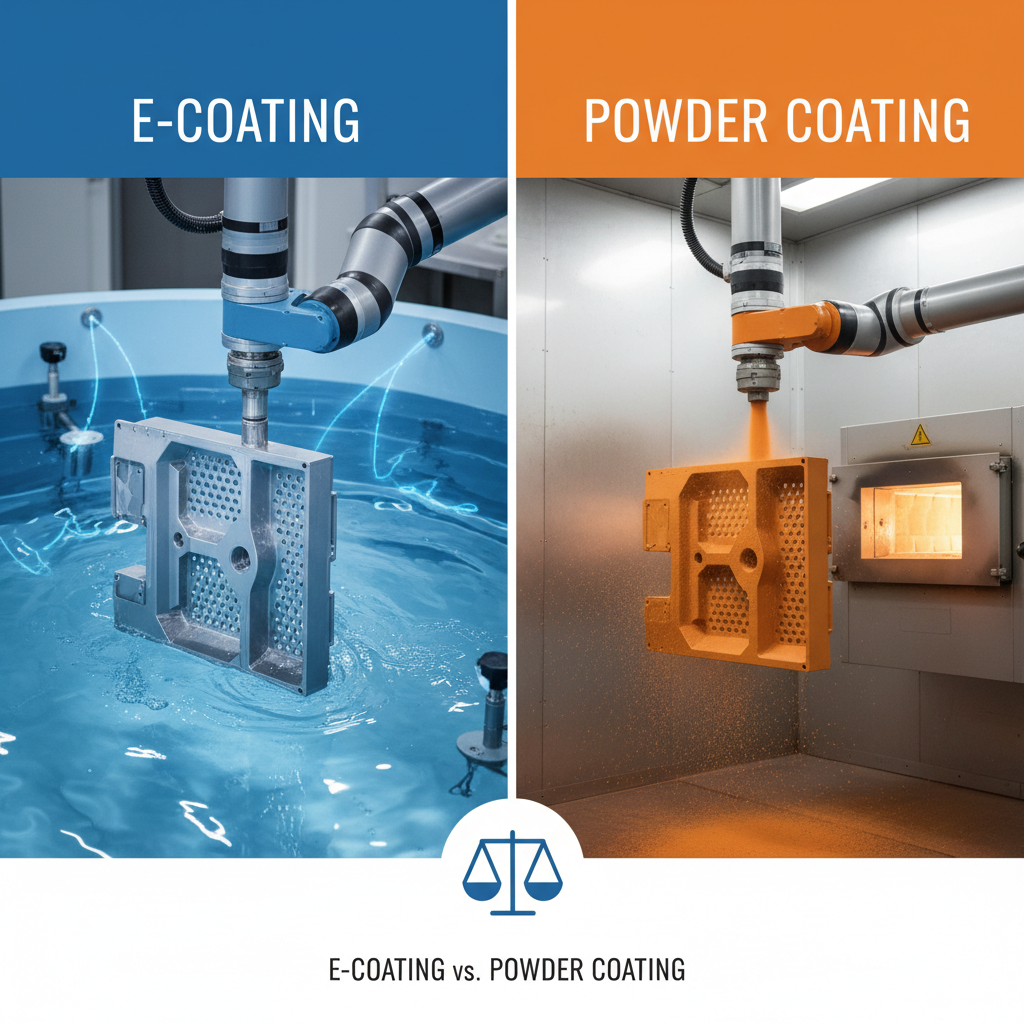
E-coating (electrocoating) uses electrical current to deposit liquid paint onto metal parts, while powder coating applies dry powder particles that are then cured with heat. E-coating excels at coating complex geometries and provides superior corrosion protection, whereas powder coating offers thicker films, better durability, and lower environmental impact for simpler part configurations.
Understanding the Core Technologies
As someone who’s spent decades in metal finishing, I’ve seen countless operations struggle with coating selection. The difference between e-coating and powder coating isn’t just technical—it directly impacts your throughput, quality consistency, and cost per part.
E-coating (electrophoretic coating) immerses parts in a liquid paint bath where an electrical current deposits coating material uniformly. This process creates exceptional Faraday cage penetration, reaching into recessed areas that other methods miss.
Powder coating applies electrostatically charged dry particles to grounded parts, then cures them in an oven. The result is a thicker, more durable finish that’s become the gold standard for many manufacturing applications.
Performance Comparison: Where Each Technology Excels
E-Coating Advantages
Superior corrosion protection: Salt spray resistance often exceeds 1,000+ hours
Excellent coverage uniformity: Reaches complex geometries and blind holes
Consistent film thickness: Typically 0.8-1.2 mils with minimal variation
High transfer efficiency: 95%+ utilization reduces material waste
Automated process control: Minimal operator intervention required
Powder Coating Advantages
Exceptional durability: Film thickness ranges from 2-10 mils
Zero VOC emissions: Environmentally compliant without complex air handling
Cost-effective operation: Lower material costs and simpler waste management
Color flexibility: Easy changeovers and custom color matching
Overspray recovery: Up to 98% powder reclaim in properly designed systems
Real-World Application Data
Based on our engineering assessments across hundreds of installations, here’s what the numbers tell us:
E-coating typically works best for:
• Automotive components (chassis, suspension parts)
• Complex assemblies with interior surfaces
• High-volume production (10,000+ parts/day)
• Applications requiring maximum corrosion resistance
Powder coating dominates in:
• Architectural components (railings, panels, frames)
• Appliance and furniture manufacturing
• Job shop environments with frequent color changes
• Operations prioritizing thick, durable finishes
Cost Analysis: Total Cost of Ownership
The upfront investment tells only part of the story. Here’s the breakdown that matters to your P&L:
E-Coating System Costs
Higher capital investment: $2-5M for complete lines
Complex pretreatment: Multi-stage phosphating required
Ongoing chemical management: Paint, additives, waste treatment
Energy consumption: Moderate (curing at 300-400°F)
Powder Coating System Costs
Lower initial investment: $500K-2M for complete systems
Simplified pretreatment: Basic cleaning often sufficient
Material efficiency: Overspray recovery reduces waste
Energy requirements: Higher curing temperatures (350-450°F)
The total cost per part often favors powder coating for most manufacturing operations, especially when you factor in our modular powder room designs that right-size your investment.
Quality and Consistency Factors
E-coating delivers predictable results through automated chemistry control. The electrical deposition process self-regulates, creating uniform coverage even on complex geometries. However, achieving consistent quality requires sophisticated process monitoring and regular bath maintenance.
Powder coating quality depends heavily on proper equipment integration and environmental controls. Our climate-controlled powder rooms eliminate humidity variables that cause application defects. When executed correctly, powder coating provides superior chip resistance and weatherability.
Integration Considerations for Your Operation
The choice between e-coating and powder coating impacts your entire finishing line design. E-coating requires extensive pretreatment, while powder coating systems integrate more easily with existing operations.
Conveyor requirements differ significantly. E-coating demands continuous, automated handling through multiple process tanks. Powder coating offers flexibility with batch or continuous operation, allowing you to match system capacity to your production requirements.
Space utilization is another critical factor. E-coating lines require substantial floor space for tanks and treatment stages. Our modular powder room approach maximizes throughput while minimizing facility footprint.
Making the Strategic Decision
For high-volume operations with complex parts requiring maximum corrosion protection, e-coating delivers unmatched performance. The investment pays off through reduced warranty claims and superior field performance.
For flexible manufacturing environments prioritizing cost-effectiveness and environmental compliance, powder coating systems provide the winning combination. Our turnkey powder room solutions deliver consistent results while protecting your investment with 10-year anti-corrosion warranties on critical components.
The decision ultimately depends on your specific part geometry, production volume, and performance requirements. Both technologies excel when properly implemented with the right equipment integration and process controls.
Frequently Asked Questions
Q: How do I determine which coating method is right for my parts?
A: Evaluate your part complexity, required corrosion resistance, production volume, and environmental constraints. Complex geometries typically favor e-coating, while simpler parts benefit from powder coating’s cost advantages.
Q: What are the typical lead times for each system type?
A: E-coating lines require 12-18 months due to complexity, while powder coating systems typically install in 6-12 months. Our modular approach can reduce installation time significantly.
Q: Which coating method offers better return on investment?
A: Powder coating generally provides faster payback due to lower capital costs and operating expenses. However, e-coating may deliver superior long-term value for high-corrosion applications.
Q: How do maintenance requirements compare between the two systems?
A: E-coating requires more intensive maintenance due to chemical management and complex equipment. Powder systems are simpler to maintain, especially with corrosion-resistant components and proper room design.
Moving Forward with Confidence
Both e-coating and powder coating deliver exceptional results when matched to the right application and executed with proper system integration. The key is working with partners who understand your operational challenges and can deliver quantified ROI through proven engineering solutions.
Ready to optimize your coating operations? Subscribe to our monthly Manufacturing Finishing Insights newsletter for in-depth technical analysis, case studies, and process optimization strategies. Get practical insights from six decades of finishing system expertise delivered directly to your inbox—plus early access to our new interactive coating system design tools launching this quarter.
 English
  Spanish